hold on there, it actually does have strategic advantage from a statistical perspective.
the basic notion is that for a probability of event A to occur it is proportional to the area of the event; so if larger area, larger probability, smaller area, smaller probability.
if we take that idea and apply the same basis to battleship you could say the probability as the sum of each probability of each point which is 0℅ if we span the area to infinity.
practically speaking, this is not true as you can’t span to an infinite scale, but you could say that the probability of hitting a point is 1℅ since battleship is a 10 x 10 grid so the probability is just 1/(10 * 10) = 0.01. Then the probability gets more complicated since you are being asked what is the probability of the second, third, fourth, etc… point being hit given that initial probability. the probability grows dependent on the first point being hit.
I’m sure there is a way to find algorithmically an optimal method to finding in what location are the best positions in battleship, but generally speaking, no, there are worse conditions that have a higher probability of being guessed
There’s a lower chance of getting hit on turn 1, but it takes more turns to sink a five space ship and all of the others than just one five space ship. The goal is to last more turns with at least one boat, not avoid getting hit for the longest. I don’t see the advantage.
Unless you add an extra rule requiring you to shoot the same space multiple times.
what are you going on about, that probability depends on the number of turns you get? last I checked it, no it does not depend on that.
the argument I’m trying to make is it’s statistically less likely to hit that 5 point battleship (probability is 5%) compared to the 17 points in ships spread abitrarily (probability is 17℅). IT DOES NOT DEPEND ON THE NUMBER OF TURNS IT TAKES TO SINK ALL 5 BATTLESHIP’S. The probability does depend after the first event has occurred (where you’ve hit one of those pieces). Whether you get a hit on your first turn or the first hit in 30 turns, it does not matter. probability does not depend on the number of turns it takes.
technically speaking the probability calculated at the beginning is when the number of trials (theoretically) approach to infinity. The 1/6 probability to role a six sided die on a number (for example, lets say 6) is after doing trial and error of rolling a 6. Now whether you get the 6 on the first try or the 100th try these are approximations of the 1/6 th probability. As you do more and more trials it does eventually converge to the 1/6 th probability.
So yes, technically speaking someone could hit the standalone stacked battleship in one try, probability and statistics doesn’t concern that. So if that concerns you, psychologically manipulate your openent by putting your battleship in the first row.
what are you going on about, that probability depends on the number of turns you get? last I checked it, no it does not depend on that.
I didn’t say this or anything like it. I suspect you didn’t read my comment at all.
The point you are making is that you are less likely to hit one 5 point ship than one of any among 17 points of ships. This, while true, has nothing to do with anything.
What the rest of us are talking about is whether stacking ships would help you win. The only factor in winning is if you sink all of your opponents ships before they sink all of yours. The % chance to hit the first shot is, frankly, irrelevant. Objectively, the more ships you have the longer you will last, and the higher your chance to win.
I guess you didn’t read my last part, humans are deterministic by nature; they draw trends based on patterns. if you wanted to win with one ship just place that ship in a place that is completely counterintuitive to what they expect. Having one ship does have strategic implications, that it narrows the possibility of being hit. Combine that with counterintuitive placement of said ship and your opponent is as good a player as a fish.
so does probability play a role in battleship? yes, it removes the statistical likeliness of being hit (ignoring the premise of humans drawing generalizations by pattern recognition). It is drastically less likely to hit one ship than 5, all you need to do is place that one ship in a position that is counterintuitive to the trend to remove any biases of your opponent who has played several games already.


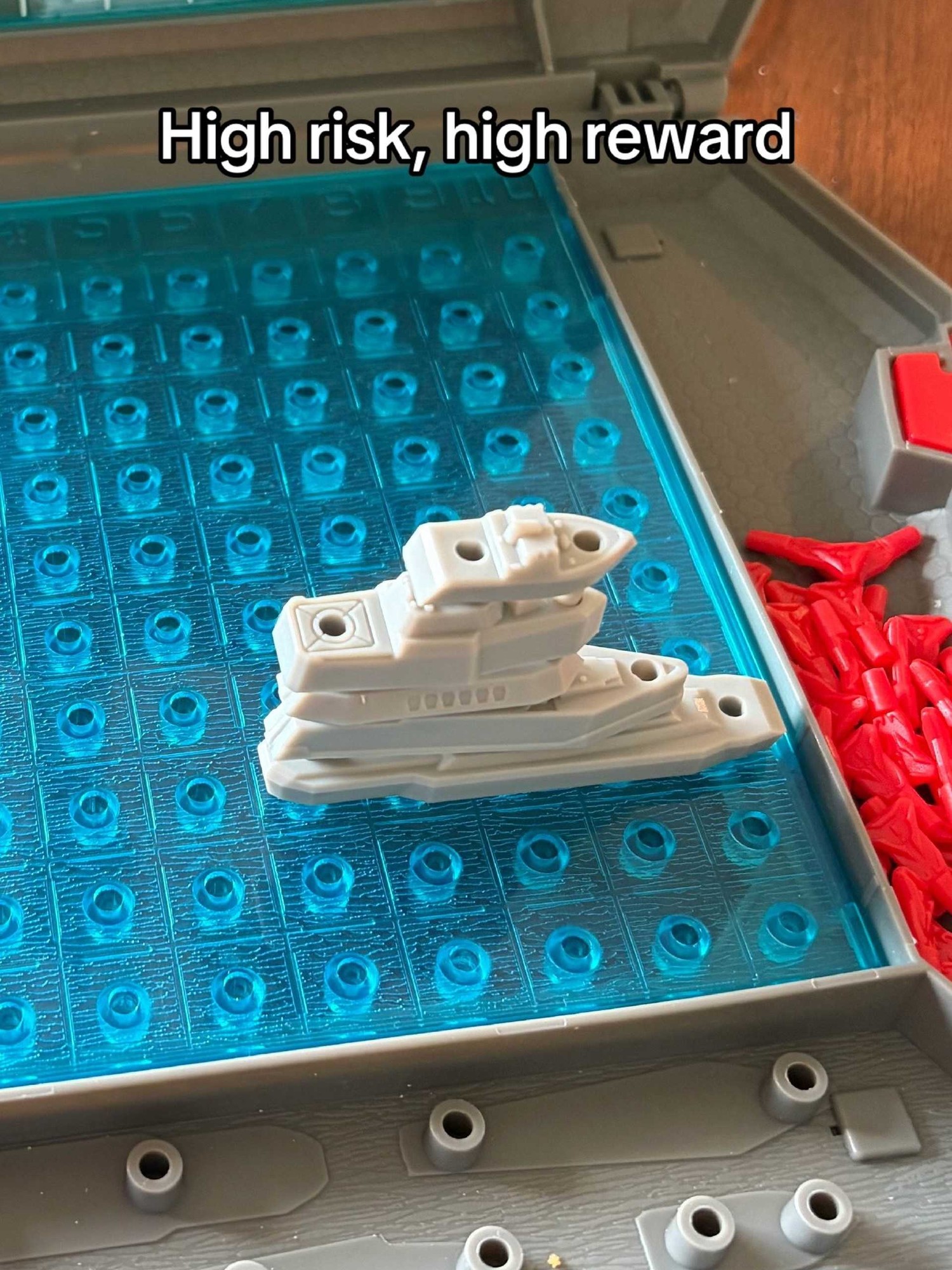
hold on there, it actually does have strategic advantage from a statistical perspective.
the basic notion is that for a probability of event A to occur it is proportional to the area of the event; so if larger area, larger probability, smaller area, smaller probability.
if we take that idea and apply the same basis to battleship you could say the probability as the sum of each probability of each point which is 0℅ if we span the area to infinity.
practically speaking, this is not true as you can’t span to an infinite scale, but you could say that the probability of hitting a point is 1℅ since battleship is a 10 x 10 grid so the probability is just 1/(10 * 10) = 0.01. Then the probability gets more complicated since you are being asked what is the probability of the second, third, fourth, etc… point being hit given that initial probability. the probability grows dependent on the first point being hit.
I’m sure there is a way to find algorithmically an optimal method to finding in what location are the best positions in battleship, but generally speaking, no, there are worse conditions that have a higher probability of being guessed
You must write statistics for Fox News.
There’s a lower chance of getting hit on turn 1, but it takes more turns to sink a five space ship and all of the others than just one five space ship. The goal is to last more turns with at least one boat, not avoid getting hit for the longest. I don’t see the advantage.
Unless you add an extra rule requiring you to shoot the same space multiple times.
what are you going on about, that probability depends on the number of turns you get? last I checked it, no it does not depend on that.
the argument I’m trying to make is it’s statistically less likely to hit that 5 point battleship (probability is 5%) compared to the 17 points in ships spread abitrarily (probability is 17℅). IT DOES NOT DEPEND ON THE NUMBER OF TURNS IT TAKES TO SINK ALL 5 BATTLESHIP’S. The probability does depend after the first event has occurred (where you’ve hit one of those pieces). Whether you get a hit on your first turn or the first hit in 30 turns, it does not matter. probability does not depend on the number of turns it takes.
technically speaking the probability calculated at the beginning is when the number of trials (theoretically) approach to infinity. The 1/6 probability to role a six sided die on a number (for example, lets say 6) is after doing trial and error of rolling a 6. Now whether you get the 6 on the first try or the 100th try these are approximations of the 1/6 th probability. As you do more and more trials it does eventually converge to the 1/6 th probability.
So yes, technically speaking someone could hit the standalone stacked battleship in one try, probability and statistics doesn’t concern that. So if that concerns you, psychologically manipulate your openent by putting your battleship in the first row.
I didn’t say this or anything like it. I suspect you didn’t read my comment at all.
The point you are making is that you are less likely to hit one 5 point ship than one of any among 17 points of ships. This, while true, has nothing to do with anything.
What the rest of us are talking about is whether stacking ships would help you win. The only factor in winning is if you sink all of your opponents ships before they sink all of yours. The % chance to hit the first shot is, frankly, irrelevant. Objectively, the more ships you have the longer you will last, and the higher your chance to win.
I guess you didn’t read my last part, humans are deterministic by nature; they draw trends based on patterns. if you wanted to win with one ship just place that ship in a place that is completely counterintuitive to what they expect. Having one ship does have strategic implications, that it narrows the possibility of being hit. Combine that with counterintuitive placement of said ship and your opponent is as good a player as a fish.
so does probability play a role in battleship? yes, it removes the statistical likeliness of being hit (ignoring the premise of humans drawing generalizations by pattern recognition). It is drastically less likely to hit one ship than 5, all you need to do is place that one ship in a position that is counterintuitive to the trend to remove any biases of your opponent who has played several games already.