Half of those “8 hours for what we will” are spent getting ready for, transportation between, and decompressing from the work hours. After time for cooking, cleaning, shopping, and other chores, we still get very little of the “what we will” hours.
You didn’t mention unpaid lunch time, making sure you get there before clock in, any phone calls or emails that happen after hours, taking kids to daycare, and all the little things that you wouldn’t be doing if it wasn’t for your job. I guess that comes out of the “8 hours of sleep” time.
I was going for the gist, not an exhaustive detailing of what most of us already know and/or doesn’t apply to everyone’s particular jobs. Nonetheless, you are absolutely correct in that there’s a LOT unaccounted for in OP’s generalization.
OP created their post 100 years ago when this sentiment was much more radical. The fact that we failed to move our positions further in one hundred years is kinda on us.
I think we need an international strike to reduce working hours (with retained compensation) from 8→6 hours. Could be a good test run for more radical change.
It’s actually gotten worse in the last 100 years. See, back then, most women would do unpaid household labour, and men would work. So your typical married household does 40 hours of work a week.
Nowadays, we have (some) gender equality, which means everyone works 40 hours a week. So your typical married household does 80 hours of paid work a week, PLUS the unpaid work that still needs to be done!
If we want to get back to doing the same work as a society as in 1926, we need to legally mandate a 4 hour workday. Anything less is a regression in workers’ rights.
It’s actually gotten worse in the last 100 years. See, back then, most women would do unpaid household labour, and men would work
This might have been true for someone in a relatively well off class position, but for the majority of working class people 100 years ago, the women also worked. Especially in things like service and textiles.
It wasn’t until the post-war economic boom with soldiers coming home and taking advantage of the GI Bill, did the “traditional” setup of women being stay-at-home mothers while the man worked, become normative. At least among white families.
People also often lived much closer to their work so commuting was just walking down the street a short ways. It wasn’t until cars became common that the sprawl and long commutes started.
Somewhat, yes - reliable public transit was also still incredibly common into WWII (and beyond in some major metros). Even if your job was downtown and you were living outside the core, you could reliably expect bus or train service within a block or two of your house, and a reliable enough network with enough stops to let you walk to your office or whatever with fair ease.
Don’t worry you have the weekend for those, which you spend 8 hours in bed, 8 hours for chores, 4 hours feeling tired, and 4 hours doing whatever you want while feeling tired.
We certainly could get rid of the servile elements of this and just have a “team”.
One partner can be stay at home (it doesn’t even have to be the same partner every day) to handle admin and support while the other does some kind of labour.
But yeah that would keep unemployment too low and is therefore not something elites want changed.


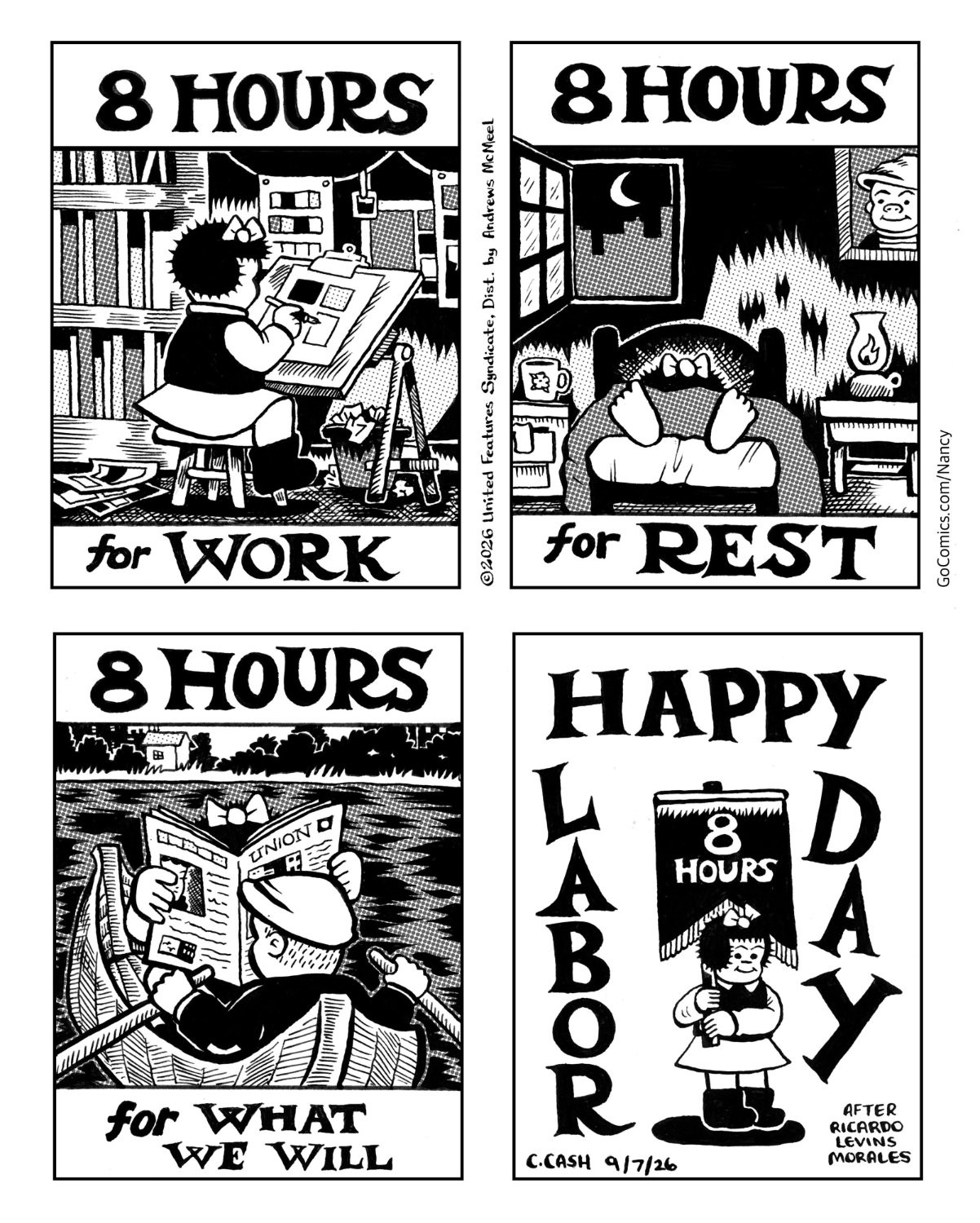
Half of those “8 hours for what we will” are spent getting ready for, transportation between, and decompressing from the work hours. After time for cooking, cleaning, shopping, and other chores, we still get very little of the “what we will” hours.
You didn’t mention unpaid lunch time, making sure you get there before clock in, any phone calls or emails that happen after hours, taking kids to daycare, and all the little things that you wouldn’t be doing if it wasn’t for your job. I guess that comes out of the “8 hours of sleep” time.
I was going for the gist, not an exhaustive detailing of what most of us already know and/or doesn’t apply to everyone’s particular jobs. Nonetheless, you are absolutely correct in that there’s a LOT unaccounted for in OP’s generalization.
OP created their post 100 years ago when this sentiment was much more radical. The fact that we failed to move our positions further in one hundred years is kinda on us.
I think we need an international strike to reduce working hours (with retained compensation) from 8→6 hours. Could be a good test run for more radical change.
It’s actually gotten worse in the last 100 years. See, back then, most women would do unpaid household labour, and men would work. So your typical married household does 40 hours of work a week.
Nowadays, we have (some) gender equality, which means everyone works 40 hours a week. So your typical married household does 80 hours of paid work a week, PLUS the unpaid work that still needs to be done!
If we want to get back to doing the same work as a society as in 1926, we need to legally mandate a 4 hour workday. Anything less is a regression in workers’ rights.
This is a very important point. We doubled the amount of labor, but the wealth of households stayed flat.
This might have been true for someone in a relatively well off class position, but for the majority of working class people 100 years ago, the women also worked. Especially in things like service and textiles.
It wasn’t until the post-war economic boom with soldiers coming home and taking advantage of the GI Bill, did the “traditional” setup of women being stay-at-home mothers while the man worked, become normative. At least among white families.
People also often lived much closer to their work so commuting was just walking down the street a short ways. It wasn’t until cars became common that the sprawl and long commutes started.
Somewhat, yes - reliable public transit was also still incredibly common into WWII (and beyond in some major metros). Even if your job was downtown and you were living outside the core, you could reliably expect bus or train service within a block or two of your house, and a reliable enough network with enough stops to let you walk to your office or whatever with fair ease.
And the “lunch in your own time” means I’ll be at work for 9 hours anyway
Wake up 1 hour before you leave, 1 hour commute there, 1 hour home eats another 3 hours that for some reason come out of your personal time slot.
Lunch time is a farce too.
Don’t worry you have the weekend for those, which you spend 8 hours in bed, 8 hours for chores, 4 hours feeling tired, and 4 hours doing whatever you want while feeling tired.
The weekend which, by the way, is another concept that labor unions had to fight and died for.
Yeah, life was a lot simpler when your wife/servant prepped all your food and work was a fifteen minute walk away.
We certainly could get rid of the servile elements of this and just have a “team”.
One partner can be stay at home (it doesn’t even have to be the same partner every day) to handle admin and support while the other does some kind of labour.
But yeah that would keep unemployment too low and is therefore not something elites want changed.
Not at today’s prices, is my point.
deleted by creator
Yeah, that’s not far from it. But we used to find a couple hours a night to spend time together, and that was nice.
I’m not sure how you’d make enough mess in 4h to need 4h of cleaning. Unless you have kids, and then yeah, that tracks.
plenty of those idiots drive hr+ a day to work
That’s the world executives still live in, contributing significantly to the disconnect between their realities and those of their workers.
listen, do not overlook: they are bad